
Nutrient uptake and removal by runner peanut cultivars of different maturity groups
Published on
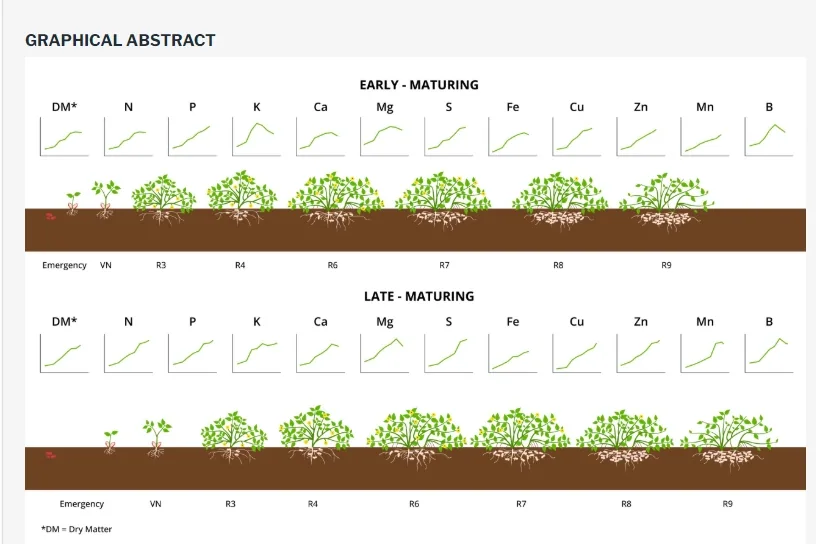
HIGHLIGHTS
Late-maturing cultivar had higher biomass yield, uptake, and removal of nutrients.
The uptake peak of B and K occurred between stages R5 and R6.
Despite the high rate of K uptake, only 22% is removed.
Approximately 70% of the N uptake by peanuts is removed.
ABSTRACT
Modern runner-type peanut cultivars have high yield potential, but little is still known about the dynamics of nutrient uptake by these cultivars and whether nutrient uptake differs between maturity groups. This study evaluated the growth, nutrient uptake, and nutrient removal of runner-type peanut cultivars with early and late maturity. The study was conducted in the field in the 2021/2022 season, in a sandy soil environment in southeastern Brazil. Treatments consisted of runner-type peanut cultivars (early and late maturity) and the phenological stage of sampling (V4/V5, R2/R3, R4, R5, R6, R7, and R8). Average pod yields were 4.0 and 5.9 Mg ha-1 for the early and late-maturity cultivars, respectively. Uptake of P, Cu, and Zn was linearly increased until stage R8. Nitrogen uptake continued until stage R7 for the early-maturity cultivars and stage R8 for the late-maturity cultivar. Potassium and B uptake did not increase after stages R5 and R6, respectively. For all other nutrients, maximum uptake occurred between stages R3 and R7. Leaf contents of all nutrients were within the sufficiency range, except Fe, which was higher than needed. Maximum macronutrient uptake (late-maturity cultivar) rates were 300, 28, 215, 76, 31, and 19 kg ha-1 for N, P, K, Ca, Mg, and S, respectively, and the maximum micronutrient uptake rates were 2350, 95, 391, 659, and 414 g ha-1 for Fe, Cu, Zn, Mn, and B, respectively. Maximum macronutrient removal rates were 210, 20, 48, 15, 7, and 12 kg ha-1 for N, P, K, Ca, Mg, and S, respectively, and the maximum micronutrient removal rates were 967, 59, 236, 153, and 136 g ha-1 for Fe, Cu, Zn, Mn, and B, respectively. Late-maturity cultivar had higher biomass production and greater uptake of all nutrients except K and Fe. The uptake of K and Fe was the same for both maturity groups.
Read articleSee also
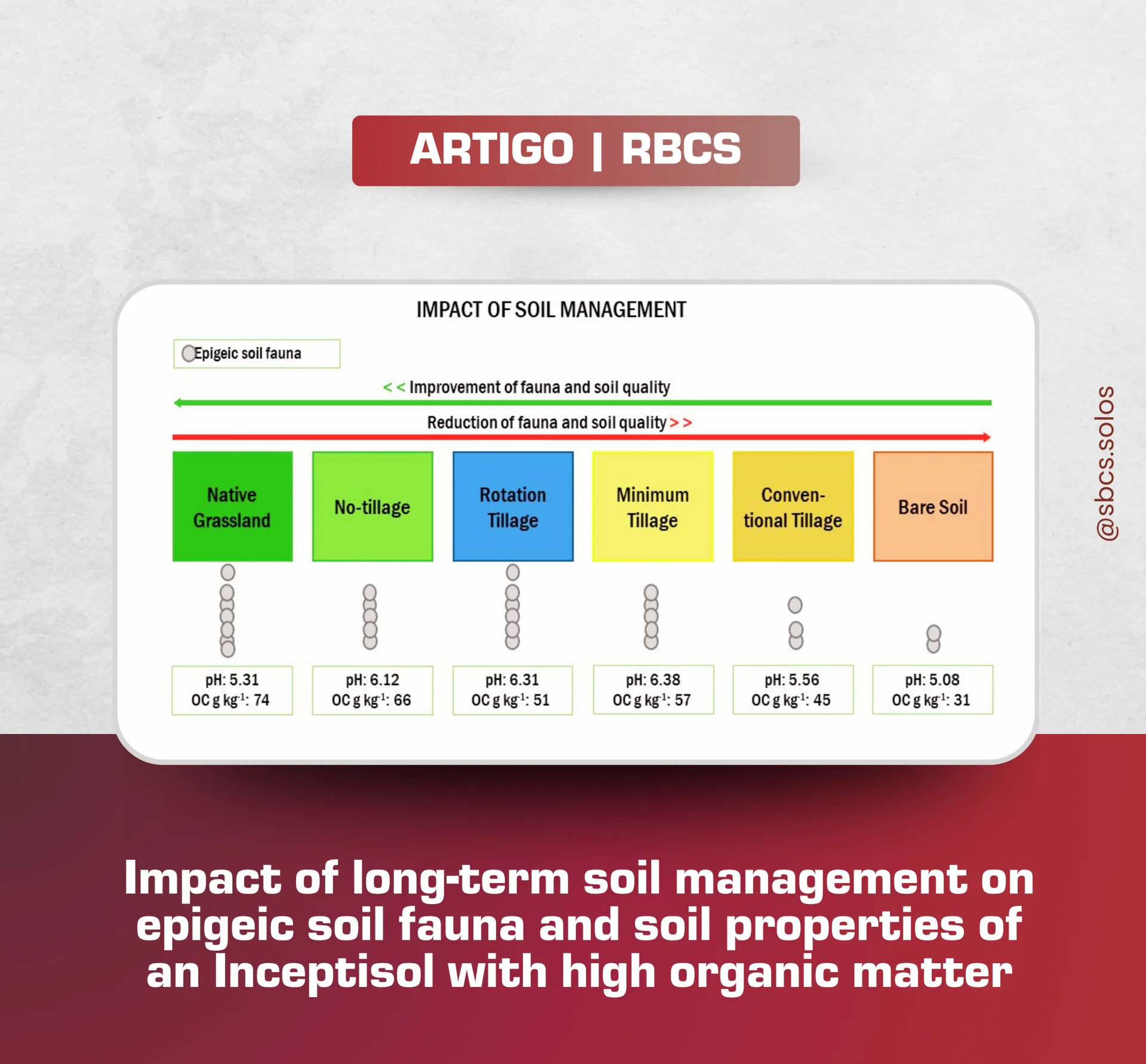
Impact of long-term soil management on epigeic soil fauna and soil properties of an Inceptisol with high organic matter
📘 New article in the Revista Brasileira de Ciência do Solo (RBCS) Impact of long-term soil management on epigeic soil fauna and soil properties of an Inceptisol with high organic matter Authors: Neuro Hilton Wolschick,…
Read more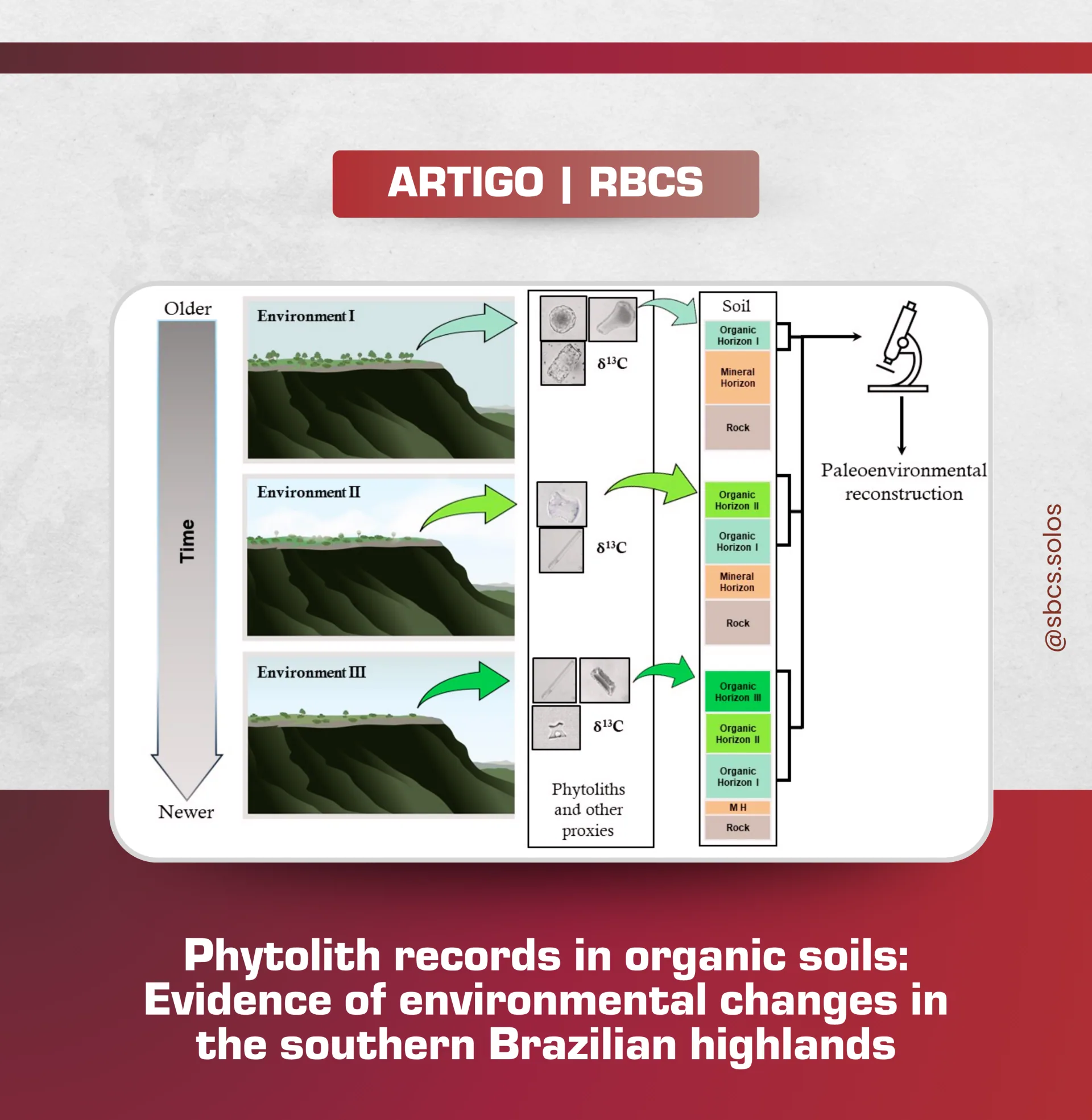
Phytolith records in organic soils: Evidence of environmental changes in the southern Brazilian highlands
📘 New article in the Revista Brasileira de Ciência do Solo (RBCS) Phytolith records in organic soils: Evidence of environmental changes in the southern Brazilian highlands Authors: João Pedro Comendouros Scott, Carlos…
Read more
Cover crops influence the physical hydric quality of a tropical sandy soil under no-tillage cotton cropping
HIGHLIGHTS The results of this study suggest that from the physical properties of the soil analysed, only the PR was influenced by the use of cover crops. At the surface physical limitations due to aeration occurred…
Read more