News
What is a scientific review [parecer científico] worth?
Published on
Anyone who has served as editor of a scientific journal knows the situation well. A manuscript arrives, passes initial editorial screening, and seems interesting enough to send out for peer review. Then begins a stage that often becomes the most difficult part of the entire process: finding qualified researchers willing to review it. We invite two, three, five, ten researchers. Some decline. Many never respond. It is not unusual for a manuscript to sit in the system for weeks, not because it is under review, but simply because we have not yet found anyone willing to review it.
As an associate editor of Revista Brasileira de Ciência do Solo, I have felt this problem more and more acutely. In 2025, Nature ran a feature on what it called the peer-review crisis. Scientific output and the number of submissions have grown, but the time researchers have available to evaluate them has not kept pace (Adam, 2025). The result is an increasingly overloaded system. Perhaps it is time to discuss a central question: why not pay reviewers?
A good review takes a great deal of work. The reviewer must understand the objectives and methods, assess the results, identify conceptual or methodological problems, check whether the conclusions are supported by the data, and write a report that helps the editor reach a decision and, ideally, helps the authors improve their work. This requires specialized knowledge acquired over many years. It also requires time. LeBlanc et al. (2023) estimated a median of four hours for the first review of a manuscript and two hours for re-review. Based on the salaries of participating researchers, the authors calculated an average value of US$ 179 per initial review. Extrapolating to the global research system, they arrived at a conservative estimate of US$ 1.1 to 1.7 billion per year. Another study had estimated that in 2020 alone, researchers worldwide spent more than 130 million hours reviewing scientific papers, equivalent to roughly 15,000 years of continuous work (Aczel et al., 2021).
Who is paying for all this?
Largely, universities, research institutes, and researchers themselves. When a professor at a public university spends an afternoon reviewing a paper free of charge for a commercial publisher, that work is not actually free. The professor's salary is being paid, the laboratory relies on infrastructure, and the institution funds the professor's research activity. The cost exists. It is simply not borne by whoever requested the service. The issue becomes even more pressing when we consider the economics. In 2025, the Scientific, Technical & Medical division of RELX, the group that owns Elsevier, reported revenue of £2.714 billion (approximately R$ 20 billion) and adjusted operating profit of £1.035 billion (about R$ 7.5 billion), with an adjusted operating margin of 38.1% (RELX, 2026). There is nothing illegitimate about a company making a profit by providing scientific publishing services. Editing, production, maintaining platforms, and preserving and disseminating knowledge involve costs and specialized labor. The question is a different one: why does one of the most intellectually important stages of this process continue to be provided for free? A model based on volunteer work may have functioned reasonably well when scientific publishing operated on a different scale. It is fair to ask whether it remains sustainable today.
What if we paid reviewers?
For a long time, the debate over reviewer compensation rested mainly on theoretical arguments. Experimental data are now beginning to emerge. One particularly interesting case is that of the journal Biology Open. In a pilot project launched in 2024, the journal began working with preselected, paid reviewers under a model called Fast & Fair. In the pilot, a first decision accompanied by reviewer reports was reached in an average of just 4.6 working days, with no detectable decline in review quality. In light of these results, the journal decided to expand the initiative. Other experiments point in the same direction, albeit with more modest results. At Critical Care Medicine, for example, offering US$ 250 significantly increased the proportion of invitations that resulted in completed reviews, again with no detectable decline in report quality (Graham, 2025).
There are, of course, risks. Money can create undesirable incentives. Some researchers might accept too many reviews. Others might produce reports hastily just to collect payment. Minimum quality criteria would need to be established and, naturally, payment would have to be entirely decoupled from the editorial recommendation: reviewers are paid for the work done, never for the decision they suggest.
Who would pay?
Here, perhaps, lies an important distinction. Not all journals are alike. It would be unreasonable to expect a small journal run by a scientific society, university, or public institution to pay its reviewers in the same way as a large international commercial publisher. Society journals such as Revista Brasileira de Ciência do Solo were born and developed within a tradition of cooperation within the academic community itself. In this setting, reviewing a paper can still be understood as part of a system of reciprocity: today I review a colleague's work; tomorrow other researchers will review mine. Many of these journals simply do not have the resources to pay reviewers. The situation of the large commercial publishers is different.
When companies earn billions in revenue and profit from scientific publishing, it seems reasonable at least to discuss whether part of those resources should reach the scientists responsible for evaluating the content these companies publish. This is not about opposing commercial publishers. It is about recognizing that scientific peer review has economic value. In recent years, various ways of recognizing reviewers' work have emerged: certificates, review records, integration with academic profiles, and reviewer awards. These are important initiatives. But recognition and compensation are not mutually exclusive. We pay researchers to teach courses, give lectures, and provide consulting. Experts are paid to prepare technical reports, serve on committees, or evaluate proposals in countless professional settings. Why should the scientific evaluation of a manuscript be any different?
A good review is specialized scientific work. I am not arguing that every scientific journal should start paying for reviews tomorrow. The economic and academic consequences of a change of this magnitude need to be studied. But neither do I see any reason to regard reviewer compensation as incompatible with the values of science. Large commercial publishers could begin by running transparent, large-scale programs. We could test different payment levels and models and assess their effects on invitation acceptance, review turnaround time, report quality, and the geographic diversity of reviewers.
The solution may not even be a simple per-review payment. Options could include APC credits, funds allocated to the reviewer's own research, compensation after a certain number of reviews, or models combining academic recognition with financial compensation. We do not yet know which system would work best. What seems increasingly hard to believe is that we can keep expanding scientific output indefinitely while leaving unchanged a model that depends on highly qualified researchers being available to work for free. As editors, we spend a great deal of time asking: how can we get more reviewers? Perhaps we should start by asking a different question: what is the work of a good reviewer worth? Perhaps the time has come to professionalize, at least in part, the peer-review process.
References
ADAM, D. The peer-review crisis: how to fix an overloaded system. Nature, v. 644, p. 24–27, 2025. DOI: 10.1038/d41586-025-02457-2.
ACZEL, B.; SZASZI, B.; HOLCOMBE, A. O. A billion-dollar donation: estimating the cost of researchers' time spent on peer review. Research Integrity and Peer Review, v. 6, 14, 2021. DOI: 10.1186/s41073-021-00118-2.
LEBLANC, A. G. et al. Scientific sinkhole: estimating the cost of peer review based on survey data with snowball sampling. Research Integrity and Peer Review, v. 8, 3, 2023. DOI: 10.1186/s41073-023-00128-2.
GRAHAM, F. What happens when you pay peer reviewers? Nature, 31 Mar. 2025. DOI: 10.1038/d41586-025-01012-3.
RELX. Annual Report and Financial Statements 2025. London: RELX, 2026.
The above text was written by:
Clístenes Williams Araújo do Nascimento, Professor at Universidade Federal Rural de Pernambuco (UFRPE) and Associate Editor of Revista Brasileira de Ciência do Solo.
See also
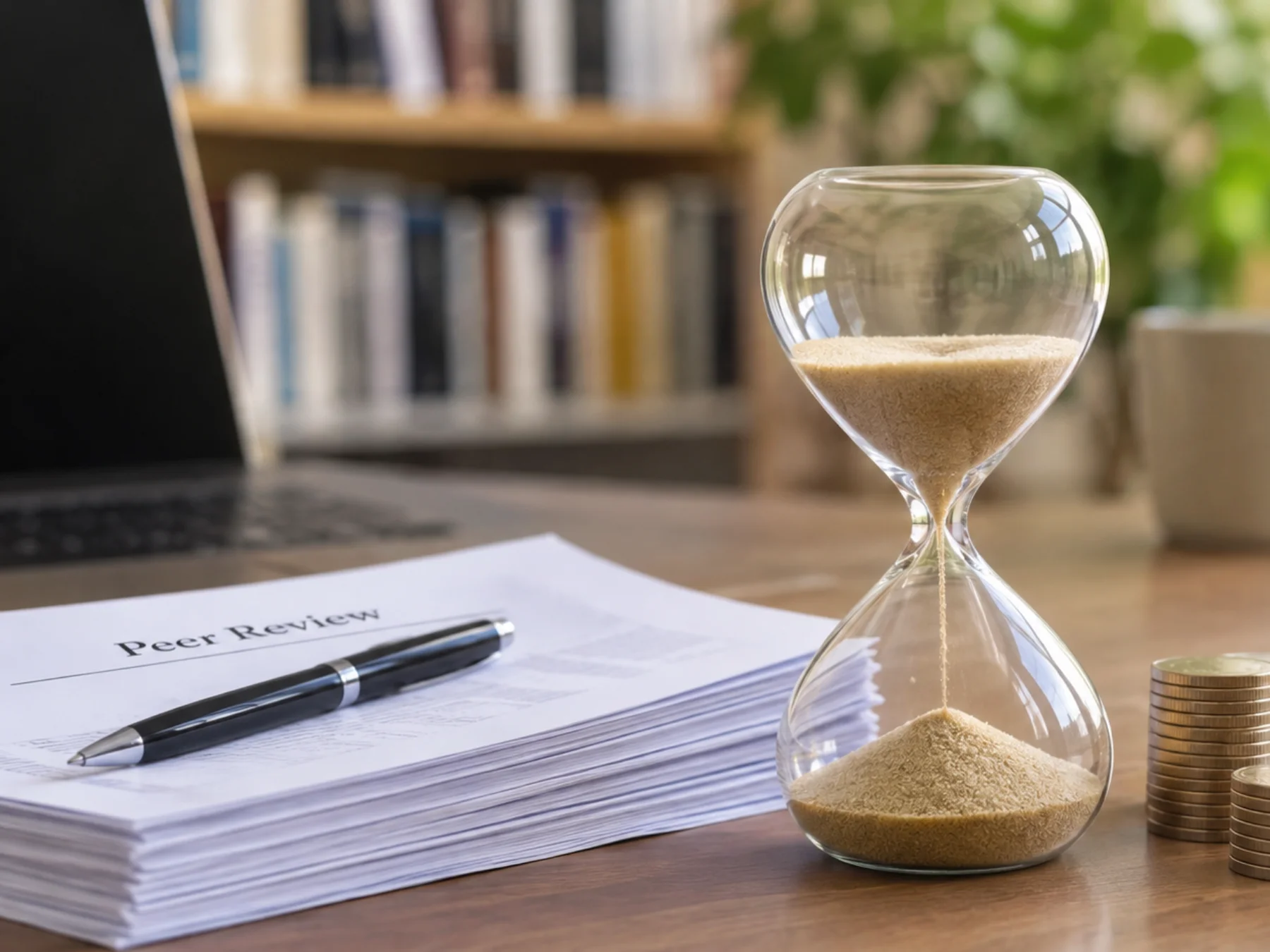
What is a scientific review worth?
The peer review crisis, researcher overload, and the debate over compensation for specialized scientific work.
Read more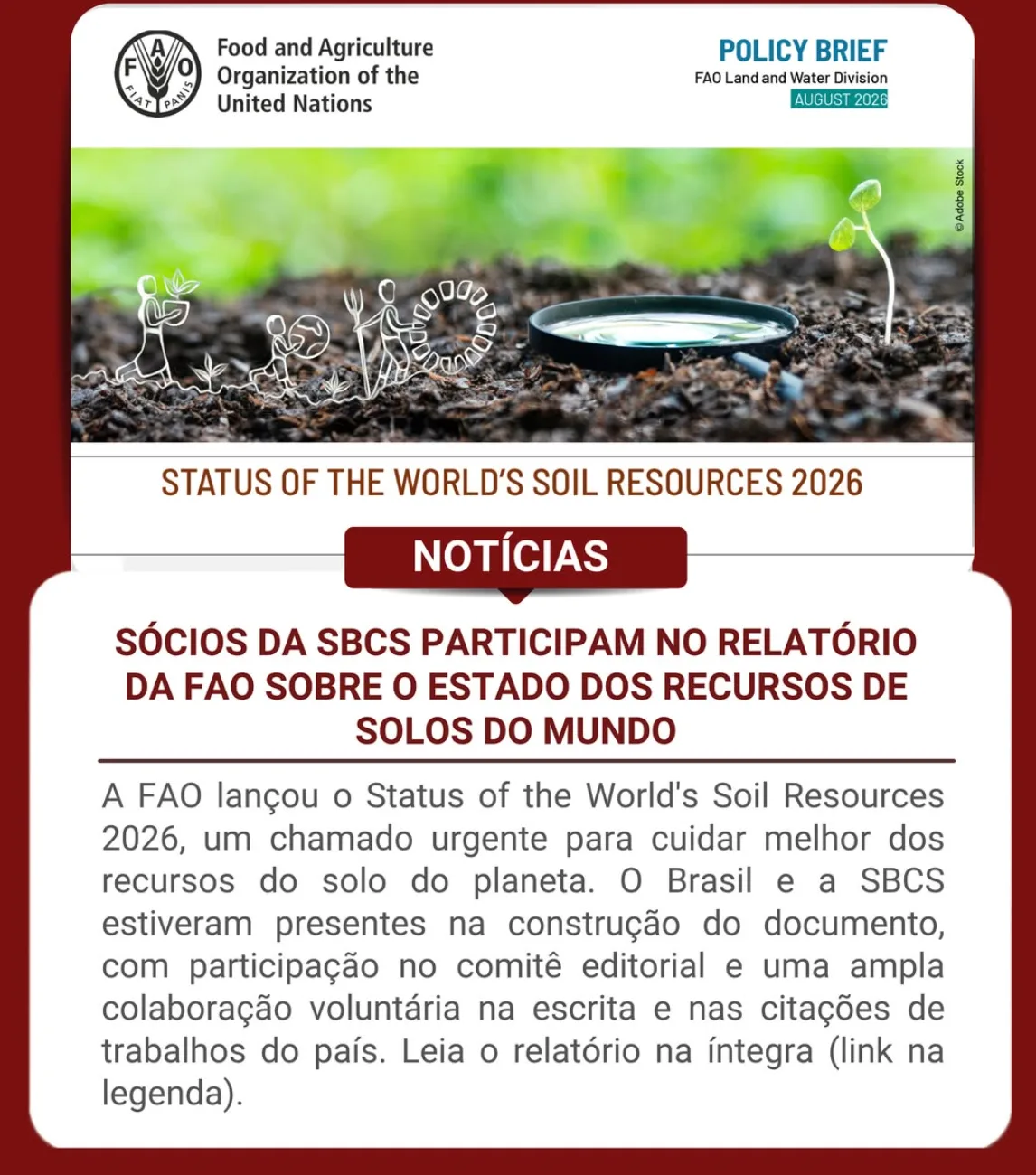
SBCS Members Contribute to FAO Report on the State of the World’s Soil Resources
The Food and Agriculture Organization of the United Nations (FAO) has released the report Status of the World’s Soil Resources 2026 (SWSR 2026), providing an overview of the state of soils across the planet. Overall,…
Read more
Knowledge of Brazilian Soils Gains National Academic Recognition
The book “Soil Health in Tropical Ecosystems: The Basis for Mitigation and Adaptation to Climate Change” was recognized by the 2026 Jabuti Academic Award in the Agricultural Sciences and Environmental Sciences category.…
Read more